The Seven Reading Strands
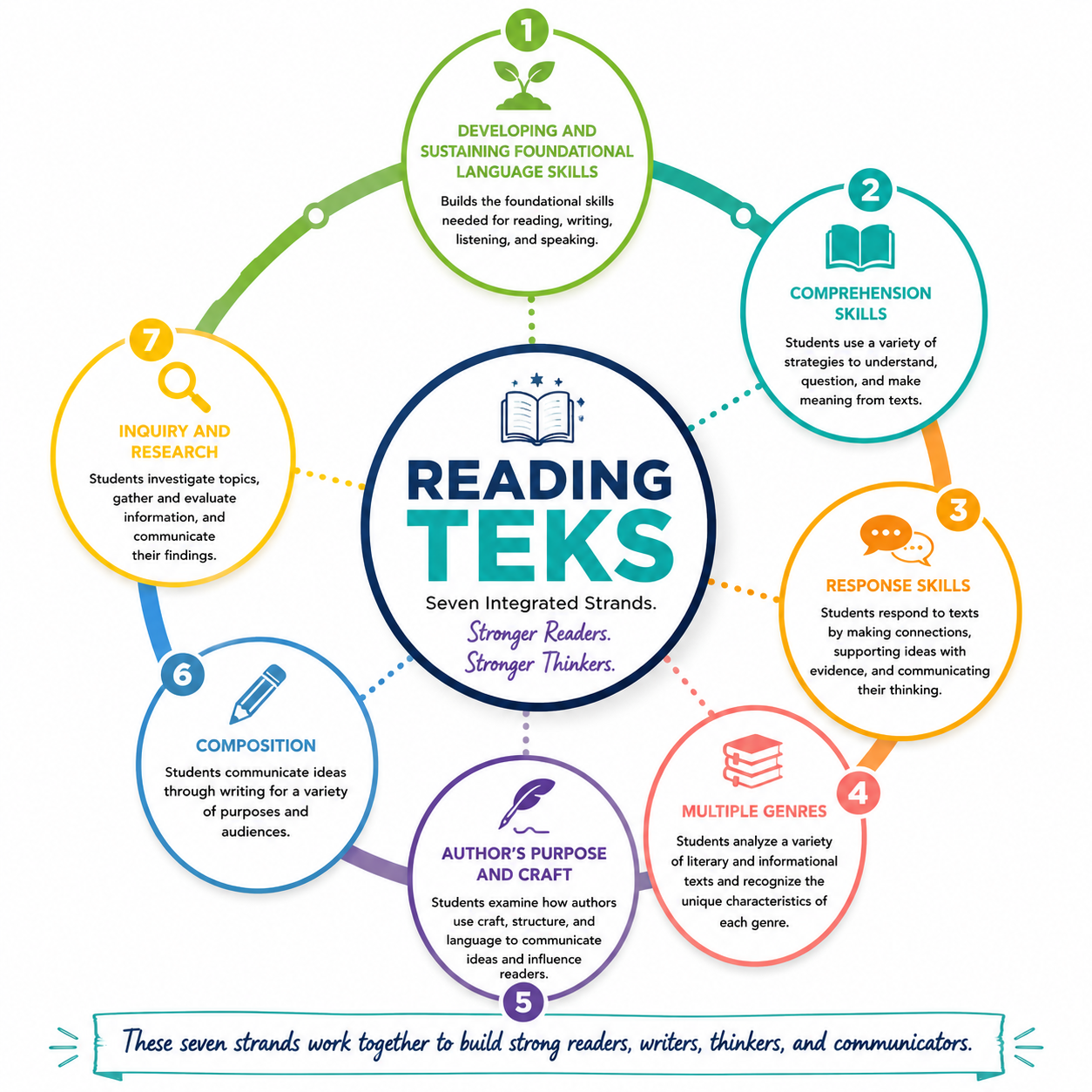
Every Texas Reading Language Arts TEKS is organized into seven integrated strands. These strands are designed to build strong readers, writers, thinkers, and communicators by developing literacy skills that connect and grow across every grade level.
Rather than teaching isolated skills, the strands work together to help students think deeply about what they read, communicate their ideas, and apply their learning in meaningful ways.
📍Place a large visual of the seven strands here.
Why Are There Seven Strands?
The Reading TEKS are intentionally organized into strands instead of individual skills.
Each strand represents a major area of literacy instruction, but none of them are meant to stand alone. As students read, they are often using multiple strands at the same time.
For example, while analyzing a character, students may also be making connections, using vocabulary, identifying text structures, and communicating their thinking through discussion or writing.
The strands are interconnected because real reading is interconnected.
The Seven Reading Strands
🌱 1. Developing and Sustaining Foundational Language Skills
Students build the foundational skills needed for successful reading, writing, listening, and speaking. This strand includes phonics, word recognition, spelling patterns, vocabulary development, and conventions of written language.
📖 2. Comprehension Skills
Students use strategies before, during, and after reading to understand, question, monitor, and make meaning from texts.
These skills support every other reading strand.
📚 3. Response Skills
Students respond to texts by making connections, supporting ideas with evidence, discussing their thinking, and communicating understanding through speaking and writing.
🧠 4. Multiple Genres
Students learn how different types of texts are organized and analyze the unique characteristics of literary and informational genres.
Examples include:
Fiction
Drama
Poetry
Informational Text
Persuasive Text
Argumentative Text
🔍 5. Author's Purpose and Craft
Students examine how authors intentionally use language, text structure, literary elements, and craft moves to communicate ideas and influence readers.
📊 6. Composition
Students communicate ideas through writing by planning, drafting, revising, editing, and publishing for a variety of purposes and audiences.
💬 7. Inquiry and Research
Students ask questions, gather information, evaluate sources, organize ideas, and communicate findings through research.
How the Strands Work Together
One lesson rarely teaches only one strand.
For example, while students read a fictional text, they might:
Use comprehension strategies to understand the text.
Analyze characters within the Multiple Genres strand.
Examine the author's craft.
Respond using text evidence.
Learn new vocabulary.
Write about their thinking.
The Reading TEKS are designed to be integrated because authentic reading requires students to use many literacy skills at once.
Vertical Alignment Across Grade Levels
The seven strands remain consistent from kindergarten through high school.
While the expectations become more rigorous each year, the organizational structure stays the same. This consistency allows teachers to clearly see how student learning progresses over time and supports meaningful vertical alignment across grade levels.
Teacher Tip
Instead of thinking,
"What TEKS am I teaching today?"
try asking,
"Which strand am I strengthening today, and how does it connect to the others?"
This small shift encourages instruction that is more integrated, purposeful, and aligned to how students naturally read and learn.
Ready to Explore the TEKS?
Now that you understand how the Reading TEKS are organized into seven strands, you're ready to see how each strand is broken down into individual standards and transformed into a MasteryMap™ that supports planning, instruction, and assessment.