The Anatomy of a TEKS™
Every Texas Reading TEKS follows the same structure. Once you understand the anatomy of a TEKS, you'll never look at a standard the same way again.
Each TEKS contains five essential parts that work together to tell you exactly what students should learn and how deeply they should learn it.
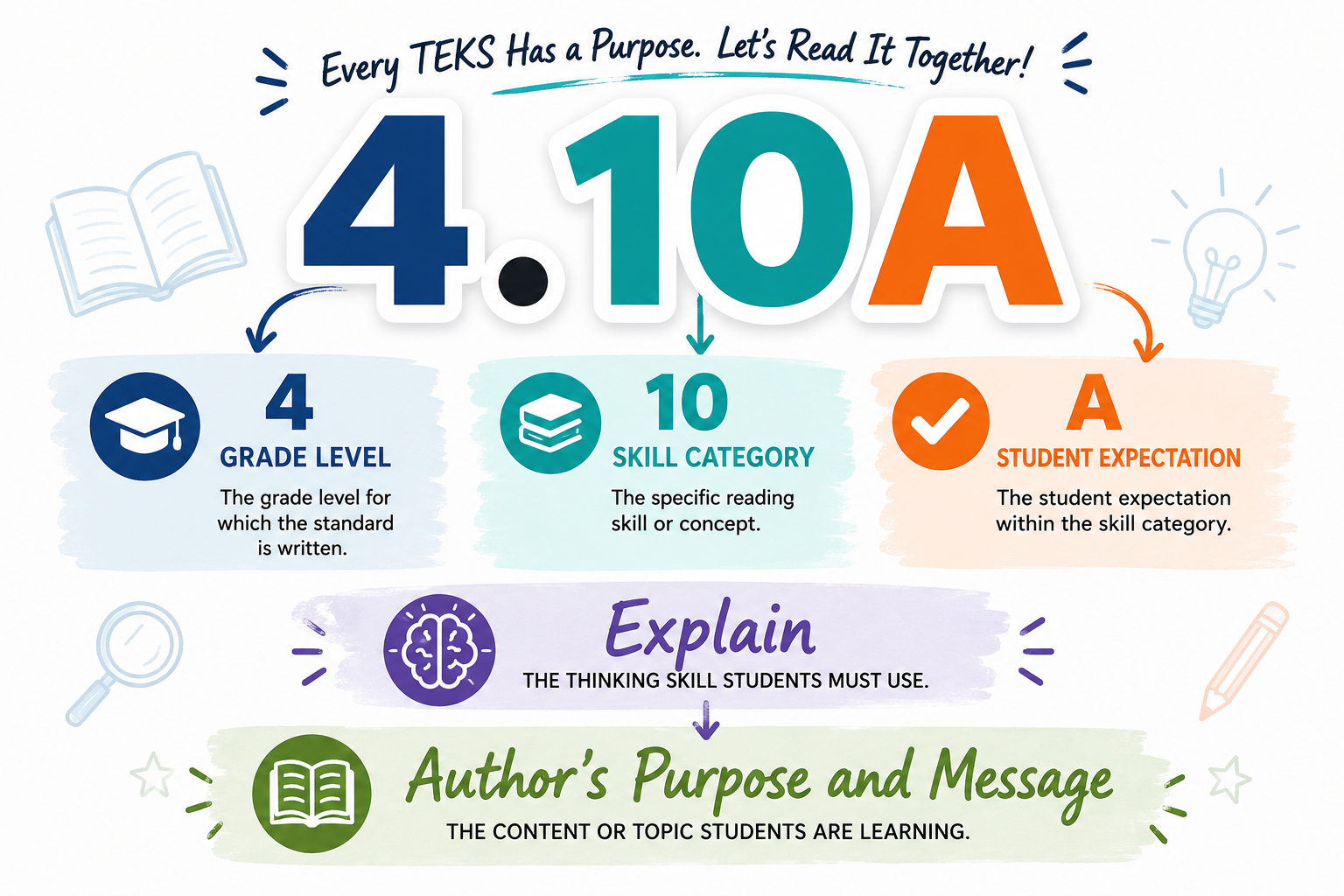
Why Understanding the Anatomy Matters
Many teachers read a TEKS from left to right without realizing that every part has a specific purpose.
When you know how to identify each part of the standard, lesson planning becomes clearer, assessments become more intentional, and instruction stays aligned to the rigor expected by the TEKS.
Instead of guessing what a standard means, you'll know exactly what students are expected to do.
Every TEKS Has Five Parts
Every Reading TEKS can be broken into the same five components:
🎓 Grade Level
The first number identifies the grade in which the standard is taught.
📚 Skill Category
The number after the decimal identifies the broader reading skill or reporting category.
✅ Student Expectation
The letter identifies the specific expectation within that skill category.
🧠 Thinking Skill
The thinking verb tells students what they must do with the content.
📖 Content
The content identifies the reading concept students are expected to understand.
Let's Break Down a Real TEKS
Example:
4.10A
Explain the author's purpose and message within a variety of texts.
Now let's identify each part.
Part
Grade Level
Skill Category
Student Expectation
Thinking Skill
Content
Example
4
.10
A
Explain
Author’s Purpose and Message
Teacher Tip
One of the biggest mistakes teachers make is focusing only on the content.
Many teachers see Author's Purpose and immediately begin planning activities.
But the most important word in the standard is often the thinking skill.
Changing just one verb changes the rigor of the lesson.
Compare these examples:
Explain Author's Purpose
Analyze Author's Purpose
Compare Author's Purpose
Infer Author's Purpose
Although the content stays the same, the thinking students must do is completely different.
Always identify the thinking skill before planning instruction.
Why This Matters for Instruction
Understanding the anatomy of a TEKS helps teachers:
✔ Plan lessons with greater purpose
✔ Match instruction to the intended rigor
✔ Write stronger learning objectives
✔ Create better classroom assessments
✔ Ask higher-level questions
✔ Help students master the standard—not just complete an activity
How This Connects to the MasteryMap™
Every MasteryMap™ begins by breaking apart the TEKS.
Once the standard has been unpacked, teachers can clearly see:
• what students are learning
• how deeply they must think
• common misconceptions
• instructional strategies
• classroom examples
• assessment ideas
Understanding the anatomy of a TEKS is the first step toward teaching with confidence.
Ready to See It in Action?
Now that you understand how every TEKS is organized, explore a sample MasteryMap™ to see how each part of the standard is transformed into a classroom-ready planning tool.